
Bend Previous Residents by Record Era
Who lived at a Bend address before today is not answered by one record. The county parcel record identifies the current property account and present ownership context. Recorded instruments carry the legal title sequence. Directories, phone books, census rolls, permits, maps, and obituaries add date-specific clues about people or the building. The table separates those layers so a title transfer is not mistaken for occupancy and a subscriber is not mistaken for an owner.
| Source | Years It Covers | Where Held | What It Shows |
|---|---|---|---|
| DIAL property record | Current online county property data; historic cutoff not stated | Deschutes County DIAL | Parcel account, owner mailing versus situs, tax, sales, and map links |
| Official Records | 1983-present | Clerk Digital Research Room | Recorded-document name, date, and citation chain |
| Deed Records and name indexes | Deed volumes 1871-1982; name indexes 1871-1984 | Clerk Records Research | Historic conveyances and party-index trail |
| City directories and phone books | Circa 1940-1990, plus selected teen and twenties editions | Deschutes Historical Museum | Historical address and subscriber clues |
| Census, permits, and maps | Census 1850-1930; City permits from 1993; maps 1913-1928 | DPL, CityView, and City Historic Site Maps | Household date, project context, or building context |
For a recent question, start with the DIAL parcel and the current recorded-document leg. For an older house, anchor the address to a legal description, then select the historical deed series and a nearby directory or census date. If online access does not answer the question, the Clerk counter, a copy request, the library, Museum appointment research, and archival inquiries remain part of the local route.
Begin Bend Previous Residents With a Parcel
Use DIAL and its Property Address (Situs) search to open the current parcel. Save the map/taxlot, account, situs address, legal description, subdivision, lot or block, current owner mailing name, and displayed sales or Tax Lot History links. DIAL also supports owner name, account number, map/taxlot, subdivision, mobile-home park, and interactive-map modes. The parcel identifiers are more stable than an old street address by itself.
Keep mailing information separate from the situs address. DIAL's account summary can show a mailing name and address, but that may be a post-office box, trustee, manager, government office, or out-of-area owner. It does not prove that the addressee lived at the Bend property. The current account is a starting point for previous residents, not a complete household roster.
The Museum historic-property research page links the local property trail to City preservation, maps, and County resources.

Its local approach reinforces the useful order: establish place first, then add date-specific records instead of treating one address search as the whole history.
Note: Preserve a map/taxlot and legal description with the street address, because each can resolve a different historical mismatch.
Trace Bend Previous Residents Through Deeds
The Deschutes County Clerk records instruments affecting title. Once DIAL supplies the parcel bridge fields, use the Digital Research Room to locate the current acquisition by party name, recording date, document citation, or, for historical work, book and page through Advanced Search. Match the legal description, subdivision, lot and block, or map/taxlot before moving backward. A street address is not necessarily the Clerk's primary index key.
- Save the current DIAL account, legal description, subdivision or lot and block, and any sale clue.
- Locate the latest acquisition instrument by party names and its date or known citation in the Digital Research Room.
- Read enough of the record to confirm the same parcel, not a similar address, unit, or lot.
- Treat the seller or grantor as a candidate prior owner, then locate that party's earlier acquisition as a grantee.
- Repeat only when the legal description or parcel context still matches, and move to the historical index route at the record-series cutover.
- Grantor and grantee
- The grantor transfers an interest; the grantee receives it. Verify the index direction before assigning either role.
- Chain of title
- The linked sequence of instruments affecting the same parcel. It traces legal interests, not a list of occupants.
- Legal description
- The recorded parcel description, such as subdivision lot and block or a metes-and-bounds description, used to match land across records.
Trust, estate, corporate, family, and corrective documents can change title without showing who occupied the address. Label the result as an owner or recorded party unless a different source supports an occupancy claim.
Bend Previous Residents at the 1983 Cutover
Deschutes record series change at a date that matters for a backward trail. Official Records begin in 1983 and are available in the Digital Research Room. Older research uses Deed Records, historic volumes, and direct or indirect name indexes. The Clerk's research guidance states that Deed Record volumes cover 1871 through 1982, while the direct and indirect deed indexes reach 1871 through 1984. Use the series name with every citation so the same volume or page number is not read as the wrong record family.
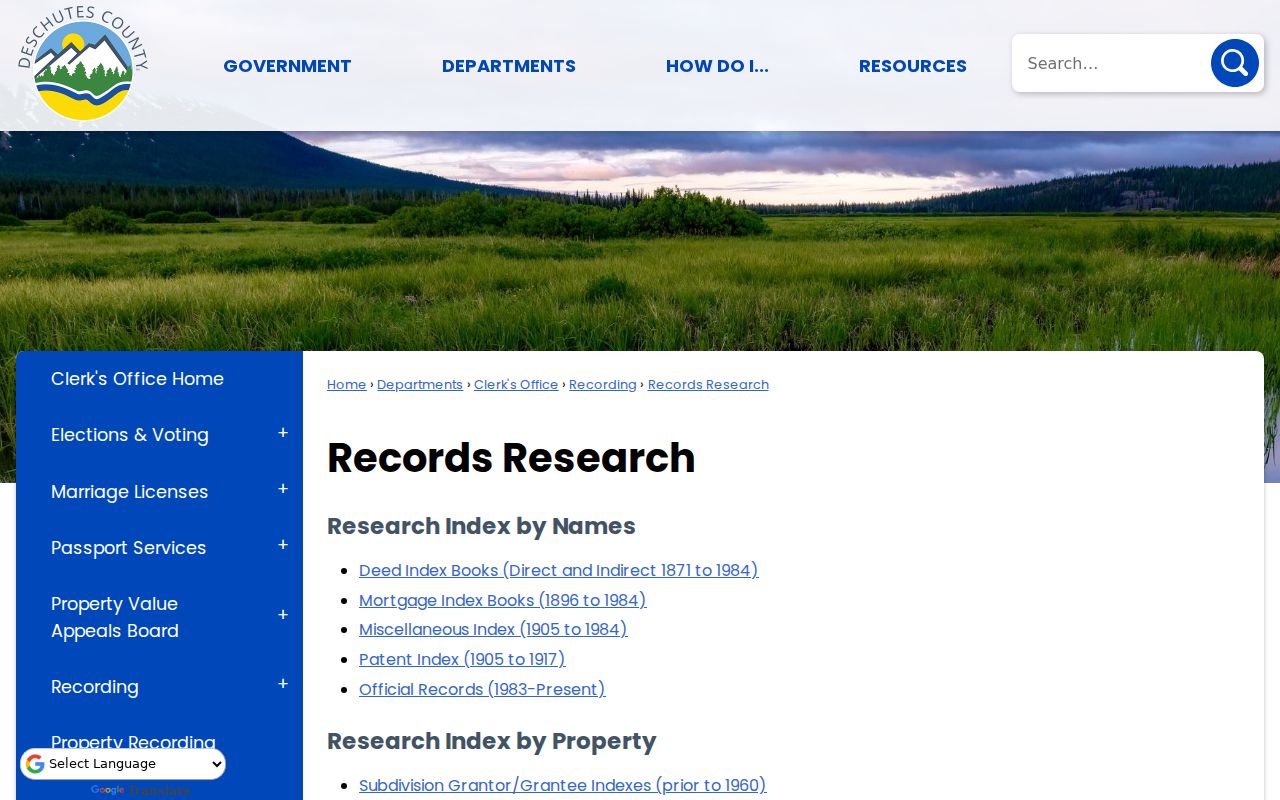
The County Records Research page is the documented historical route for deed, mortgage, miscellaneous, patent, subdivision, and water-rights material. The direct and indirect deed indexes have their own 1871-1984 coverage; mortgage books run 1896-1984, miscellaneous indexes 1905-1984, and patent indexes 1905-1917. Select the specific index that fits the type and era of the question.
The Records Research page is the source for this Bend previous residents historical-index route.
When the online form or index does not settle the chain, ask the Clerk about the correct book, historical volume, counter access, or copy procedure rather than guessing from an address.
Bend Previous Residents Before County Formation
Deschutes County was organized from Crook County on December 13, 1916. Its first 19 deed-record volumes contain transcribed Crook County material, which is a vital local detail when a title trail crosses the county-formation date. Do not describe an absence in an early Deschutes search as a missing history until Crook County context and the appropriate archive route have been checked.
Instruments dated from December 13, 1916 through December 31, 1982 are cited by numbered Deed Record volume and page. Official Records started January 1, 1983. This chronology shows how Bend property history was kept: one address may need both current county records and earlier Crook County material. Record the series, volume or document number, recording date, and legal description together.
The County historic real-property records page groups the scanned Deed Records in volumes through 366 and points researchers to the modern document search.
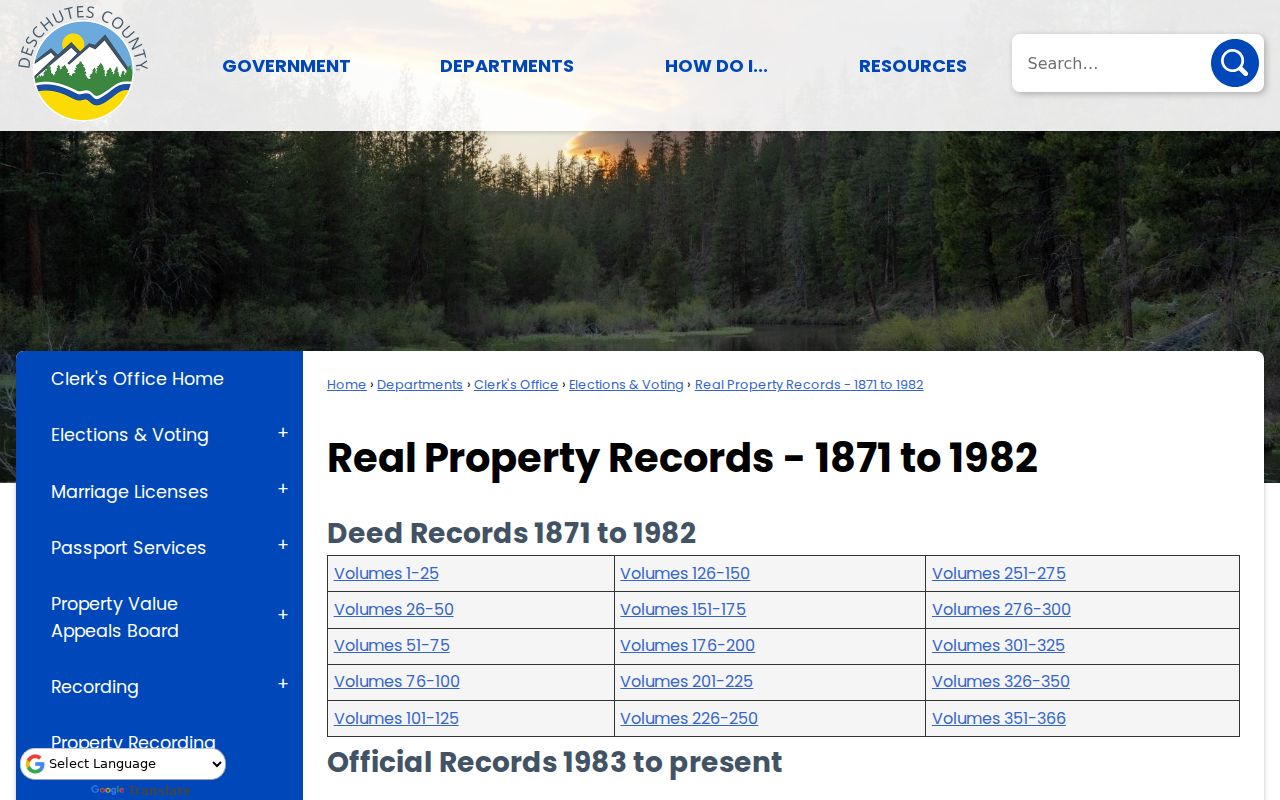
The published historical volume groups show where an older citation belongs, while certified copies still follow the Clerk's request route.
Note: A dated series citation is stronger than the vague label “county records,” especially when a property trail crosses 1916 or 1983.
Bend Previous Residents in Household Sources
Owners are only part of who lived here before. The Deschutes Historical Museum has Bend, Redmond, and Prineville directories and phone books from roughly 1940-1990 with selected teens and twenties editions. Ask whether the exact volume includes an alphabetical, telephone, or reverse and criss-cross section. A reverse section can connect an address to a subscriber or occupant clue, but it is not proof of title or a complete household.
Deschutes Public Library adds Oregon census rolls for 1850-1930, Oregon vital-index microfilm, and historical newspapers. A household process can be kept simple: address and parcel → nearest directory edition → earlier or later edition → census date → obituary, probate, or recorded document check. Pair sources by year, since a census fixes one date while a directory may fill some of the years between it.
The historical collections themselves are detailed on the Bend city directory page. In a house trail, use them as dated evidence and identify the relationship precisely: directory subscriber, census household, owner, permit contact, or probate heir.
Bend Previous Residents Through Maps and Permits
City Sanborn sheets for 1913, 1917, 1920, and 1928 can test the physical setting of an early Bend address. They show building footprint, material, or use context, not a person list. County R. B. Gould field books from 1910-1940 add road, subdivision, plat, and survey context across more than 60 subdivisions, although the County warns that their handwritten index is bare and imperfect.
For a later layer, CityView Permit Lookup says historic City permits reach back to 1993, and County DIAL Development and Permit tabs can show tax-lot permit, inspection, work-description, and development information where available. A permit may identify a project contact or work history. It should not be reported as proof of residence without another source.
A current Bend mailing address may also lie in City territory, County territory, a post-office box, or the urban growth boundary. For edge property, check the present City limit and the County parcel record before choosing a City or County permit or archive channel.
Bend Previous Residents Evidence Labels
A sound address history preserves what each source actually establishes. Mark a deed result as owner or recorded party. Mark a directory result as subscriber or occupant clue. Mark a census result as a household on its census date, and a permit result as a project contact. This approach leaves room for a property held by a trust, an estate, a business, or a family member without turning a likely story into a false fact.
The Clerk's public counter is at the Deschutes Services Building, 1300 NW Wall Street, Suite 202, Bend. It is open Monday through Friday from 8 a.m. to 5 p.m., except 8-9 a.m. on the second Thursday each month; recording and marriage services stop at 4 p.m. Certified-copy requests can also be mailed to the Recording Department, PO Box 6005, Bend, OR 97708-6005. The Clerk's form says to allow ten days.